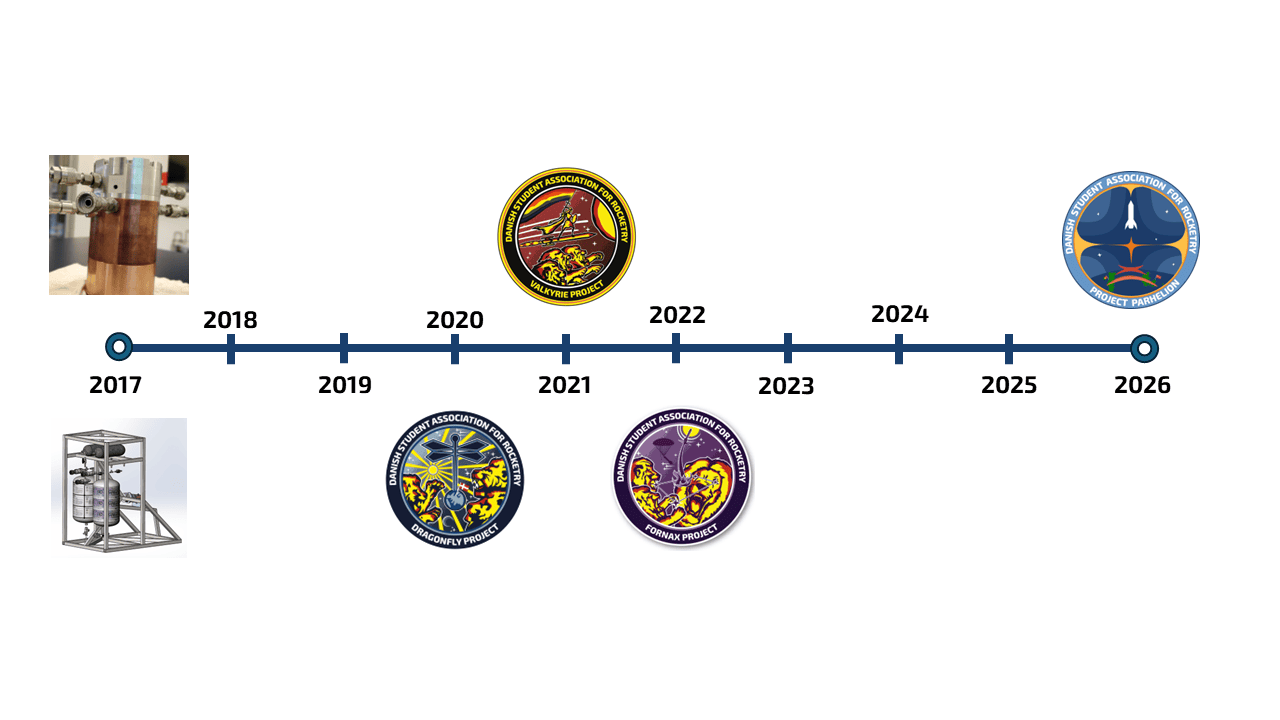
Projects
Projects are essential to progression. The completion of certain projects allow for newer and more ambitious undertakings. To keep focus aligned and concentrated, DanSTAR organises all of its work into projects that the entire team focuses on. Keeping the amount of active projects low means that effort can be put into progressing in specific areas such as either rocket development or launch rail design.
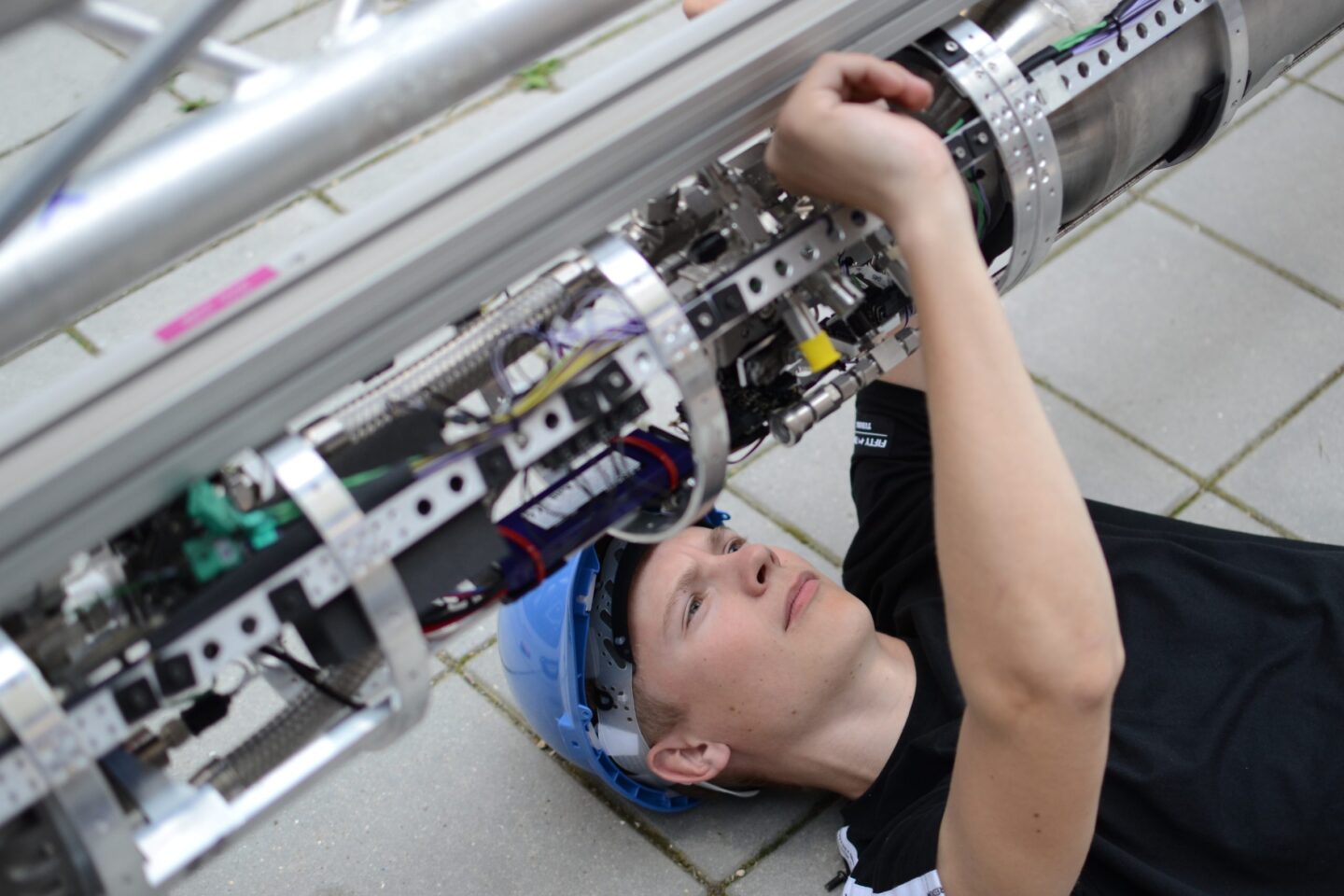
The Parhelion Project

Project Parhelion is the next rocket being built by DanSTAR. It utilizes the upgrades made during the project Fornax campaign and builds on key systems like landing, the outer shell, and the flight computer.
The rocket is planned to be roughly 4m tall with a 220mm diameter. It will be propelled by the Gnome Child Mk IV engine using a mixture of N2O as oxidizer, isopropyl alcohol (IPA) as fuel, as well as water and tetraethyl orthosilicate (TEOS). As the TEOS is burned inside the combustion layer it creates a ceramic layer that coats the inside of the engine and reflects excess heat.
The team plans on using the fuel and oxidizer tanks as structural support instead of using an inner frame to reduce overall mass. This decision came after a research trip to Copenhagen Suborbitals in late 2025.
The team successfully completed a hot fire of the rocket engine in March of 2026, following a complete redesign and rebuild of the test stand piping after an anomaly that occurred during the Fornax campaign. This test marks the first time in four years that DanSTAR has turned on their engine.
The Fornax Project

Project Fornax was the planned third rocket by DanSTAR. It iterated on all the previously established systems and greatly improved the designs of the recovery system, electronics, airframe, software, and overall aerodynamics.
The rocket was designed for nitrous oxide, N2O, as oxidizer and a fuel mixture of 89 wt% isopropyl alcohol (IPA), 10 wt% water and 1 wt% tetraethyl orthosilicate (TEOS). The propellant tank was previously used in the Valkyrie rocket.
The outer shell of the rocket consisted of five large panels in carbon and glass fibre, two of which were chosen to be as aerodynamic as possible whilst keeping the structural advantage of a tube in comparison to cut-up panels. The airframe consists of three longitudinal aluminium rails being held together by 13 bands across the rails.
The engine, Gnome Child MK IV is 3D printed in steel by Danish industry partners and is the same design as the previous rocket Valkyrie. The re-use of the engine design would allow us to skip the hotfires, but ultimately a hotfire campaign was conducted anyway. This was done primarily for educating the team, since it was a very different team than those who participated in 2021. A static fire was also planned to take place before EuRoC.
The “brain” of the rocket – the flight computer – consisted of a backplane with five slot-in boards, each of which had unique jobs to control and monitor the entire rocket. Besides the custom flight computer, we designed battery boards to monitor and charge the battery, a switch board to easily turn off power, a black box to store the valuable flight data, and a middleman board to take the outputs (pyro channels) of both of the COTS flight computers to deploy the recovery system. We used two COTS computers to ensure deployment of the parachutes.
The Valkyrie Project

Project Valkyrie was DanSTARs next step toward new heights, quite literally. DanSTARs goal with the rocket Valkyrie was to beat the world record for height reached by a student built bi-liquid rocket. The project itself included an upgrade of our electronics, software, building the Valkyrie rocket, upgrading our test stand and upgrading our launch rail.
The Valkyrie rocket was an improved rocket, based closely on the design of the Dragonfly. Valkyrie had a length of 4.6 meters, from the bottom of the engine nozzle to the tip of the nose cone. It was constructed using a frame of aluminium bands and rails, all covered in 1 mm thick panels of carbon and glass fibre. It had an outside diameter of 202 mm, giving it a length/diameter ratio of about 22.8. It had a dry weight of about 54 kg, but sat on the launch rail fully loaded with a total wet mass of about 77 kg.
After reaching the desired apogee of 9,144 m, the recovery system of Valkyrie kicked in: First, a set of two redundant CO2 capsules burst, shooting off the nose cone and ejecting a drogue chute, slowing down, as well as stabilising the descent of the rocket. Just before landing, at an altitude of about 500 m, the main chute was to be deployed using an electronically controlled servo and slows Valkyrie down for a gentle touchdown – ready for reuse!
The rocket was propelled by a new and improved version of our student designed 3D-printed steel engine, Gnome Child. The regeneratively cooled engine ran on a mix of isopropyl alcohol and nitrous oxide. The engine was pressure fed using a high-pressure nitrogen system, used to pressurise our custom-made duplex/316L stainless steel common bulkhead propellant tank.
Valkyrie used the fourth iteration of DanSTAR’s Gnome Child biliquid rocket engine as its propulsion unit.
Like its predecessors, Gnome Child Mk IV used nitrous oxide and a custom isopropanol fuel blend, and produced 3.1 kN of thrust at a chamber pressure of 19 bar with a specific impulse of 195 seconds. This put it at the forefront of efficiency among student rocket engines, and to our knowledge was the only flight-proven student-developed liquid engine in all of Europe at the time of launch.
After the successful launch of Dragonfly in 2020, the engine underwent several design improvements, saving 1.5 kg of mass and reducing the pressure drop in the cooling channels. Due to its regenerative cooling system and well-tested injector design, the engine achieved an extremely high combustion efficiency during operations. Gnome Child Mk IV was the culmination of three years of engineering, designing and testing, and is still a testimony to DanSTAR’s ambitiousness and dedication.
The Rack was the flight computer that controlled the Valkyrie rocket. It was the successor to the Stack, which was used in the Dragonfly rocket. While the Stack consisted of seven unique PCB boards stacked on top of each other, the Rack consisted of six unique PCB boards which were slotted into a backplane PCB, in much the same way RAM is slotted into a motherboard on a computer.
This slotting system allowed for boards to be independently added, removed, iterated, replaced, and tested easily throughout the entire design process of the Valkyrie rocket.
Each PCB in the Rack had a unique purpose, including controlling the flow of propellants with servo motors, measuring pressures and temperatures in the engine, and wirelessly communicating with Mission Control via on-board antennas.
Each of the six PCBs was equipped with STM32 microcontrollers, all of which communicated with each other using CAN-FD protocol, a protocol used in modern high-performance vehicles. This ensured that data and information about the rocket was gathered, stored, and transmitted to where it needed to be at all times before, during, and after the flight. Many of the Rack boards were also controlling other peripheral PCBs in the rocket which were not a part of the flight computer; the Actuator board was controlling three different Servo boards, the Main board controlled the Ignition board, and the Power Supply board monitored four different Battery boards.
The Rack was designed and programmed entirely by DanSTAR’s electronics and embedded software teams, making every aspect of it specialized for the operation of the Valkyrie rocket.
The Dragonfly Project

Although development the rocket Dragonfly was a huge part of DanSTAR, the actual Dragonfly project was larger than the rocket itself. Within the project, we developed a new engine, new flight electronics, updated our mission control software, the test stand, and much more.
The Dragonfly rocket was 4.5 meters long and consisted of an aluminum air frame with a carbon and glass fiber exterior. Weighing in with a dry weight of approximately 50 kg, the entire rocket was extremely light-weight, allowing it to reach the desired altitude of approximately 9 km.
Upon reaching its apogee, the nose cone ejected using pressurised CO2 which let the drogue chute fall out of the nose cone volume. After falling to around 500 m above ground level, a pin was released which allowed the drogue chute to deploy the main parachute. This event reduced the falling velocity of the rocket to 20 km/h.
The rocket was powered with a bi-liquid propulsion system running on nitrous oxide and a custom isopropyl alcohol blend. These propellants are fed to the rocket engine 'Gnome Child' using a 300 bar pressure-regulated cold gas inert feed system of pure dinitrogen. The propellant tank itself was a common bulkhead duplex/316 stainless steel component, which had been carefully engineered and pressure-tested to withstand immense pressures above 50 bar if necessary during operation.
The rocket was passively guided with three aluminum fins. The decision to passively guide the rocket was made to reduce complexity and the working load on an already burdened electronics and software team as an active guidance system would otherwise have had to be developed. This necessitated a high exit velocity when leaving the launch rail, which required a high start acceleration that then imposes another series of challenges we had to solve.
Gnome Child is the name of the rocket engine that propelled Dragonfly upwards for the approximately 16 second long boost phase. During this period, the rocket saw an acceleration of more than 3G as the fuel tanks emptied. Around 18 kg of pure propellant was burnt in this period.
The engine was kept cool with an advanced regenerative cooling system, meaning all of the fuel is circulated around the combustion chamber immediately before being injected into the engine. This has a two-fold advantage in that the engine is kept cool, but the fuel is also heated up, reducing the energy needed for evaporation.
This was, and is still, done in close cooperation with Danish Technological Institute who gracefully offered us the opportunity to 3D print the engine out of metal. 3D printing is a new and emerging technology within rocketry that allows for complex designs of cooling systems within the actual engine itself that could not be manufactured with traditional methods. This means DanSTAR is on the forefront within actual rocketry development, and it allows our students to get hands-on experience with state-of-the-art technology before graduating.
RICHARD is short for Robust Internal Controller for High Altitude Rocket Dragonfly. This was our internal flight computer, which additionally also controlled the test stand. Sometimes refered to as the flight stack for its many stacked PCBs, it utilised STM32 microcontrollers for a low learning curve and reliable platform to work with. The stacked PCB design allowed for easy iterations of individual computer models and made adding new features a breeze.
The internal communication was done with a modern CAN interface, the same also used in the automotive industry, which allowed the boards to communicate quickly and easily among each other, ensuring information was where it was needed when it was needed.
The multi-board design consisted of an actuator board, temperature sensor board, pressure sensor board, telemetry board, high-power board, low-power board, and lastly the main board. This configuration had all the functionality that was needed within Dragonfly during flight and recovery, and controlled everything from the auto-ignition sequence to recovery events.
When used on the test stand, a test stand board was added to the stack, which increased the amount of connected sensors and valves that could be controlled.
The launch rail is a quarter ton heavy and 13 meter tall, behemoth structure that DanSTAR had to develop from scratch to facilitate launching a rocket the size of Dragonfly. The launch inclination can be adjusted down to a single degree because of its special hinge construction. This means DanSTAR can carefully decide the rocket flight direction, which is helpful for safer launch events.
The structure itself consists of a steel center piece and legs with an aluminum mast. This ensures most of the weight is located at the bottom of the structure, making it stable even in windier conditions. The mast is in constant tension because of the steel wires which keep it firmly in place when the launch rail is deployed.
The launch rail is able to be completely disassembled, which is a requirement for shipping it to the US, in order to distribute the shipping weight throughout several flight cases.
The Test Stand

The test stand is probably the most important piece of equipment that DanSTAR has developed. At its core, it's a sturdy and portable steel frame with a fluid system, but in reality it's a complete test bed for testing everything from fluid system components to software implementation. It's a perfect and purely terrestrial replica of the Dragonfly rocket, which allows for highly accurate tests which simulate the systems inside the rocket. The key difference between the test stand and the rocket, besides being aerodynamically challenged, is the control suite. With its load cell, flow meters, and added solenoid valves it allows for much better measurements and control than what is available on the rocket.
Although the test stand project officially finished when the demo engine was successfully fired in the end of 2018, it will never truly be complete as it serves as a canvas to test new ideas in all aspects of rocket engine development and control.
In order to achieve live communication, we wrote our own mission control software. This piece of software is written from the bottom up, contains several thousand lines of code, and allows us to monitor the vitals on the test stand before, during, and after engine test firings. With the click off a button every single valve on the test stand can be actuated exactly to the position that is required and the live sensor feedback will tell you about the system response.
Additionally, the mission control software also transmits the auto sequence parameters to the engine controller so that the flight stack can operate the engine autonomously and automatically turn of the engine if operation falls outside of specified parameters. Mission control is constantly iterated on as features get added and removed according to requests from the mechanical and electrical team.
The test stand's fluid system is intended to emulate the one as seen in Dragonfly. This provides a test bed with close to the same conditions present as in the rocket itself, and build on the principles of 'test as you fly, fly as you test' laid out by Copenhagen Suborbitals.
Similar to the rocket, it contains three large volumes. A 10 L tank for storing the 300 bar dinitrogen, a 35 L insulated nitrous tank, and a 15 L fuel tank. This is approximately three times as large as seen on the rocket, allowing for quick turnover times between hot-fires by reducing fueling time as well as enabling longer duration engine burns to be test.
The Demo Engine

Initially, the demo engine was meant to showcase DanSTAR's abilities in design and operating its own rocket engines. The engine is quite small and works on simple principles, but this is perfect in order to get a grasp for what matters and what doesn't in rocket engine design. Additionally, it serves as a tool for testing the the test stand, as this engine can withstand severe hard starts and burn durations of more than 10 seconds without being actively cooled.
The copper chamber works as a heat sponge, absorbing the immense heat that is created inside the chamber during operations. This is widely refered to in literature as capacitive cooling.
Nominal thrust: 300 N
Nominal chamber pressure: 20 bar
Chamber diameter: 44 mm
Throat diameter: 11.6 mm
Chamber wall @ thinnest location: 27 mm
The nozzle of the engine can be unbolted to install an almost fool-proof ignition system deeply inside the engine for reliable engine ignition.
The demo engine is outfitted with a thorough sensor suite, capable of sensing feed pressure for both the oxidizer and fuel as well chamber pressure. It has 6 thermocouples located deeply inside the chamber wall to measure temperature at critical locations.
Contact
Delivery address:
Diplomvej, Bygning 373D, 2800 Kgs. Lyngby
Registry address:
Fysikvej Bygning 311 2800 Kgs. Lyngby
CVR-nr.:
38217216
Find us
Copyright © Danish Student Association for Rocketry 2016 - 2026, all rights reserved.